
ERC-2612 Permits Explained: Gasless Approvals for Corporate Treasuries
ERC-2612 permits let a wallet authorize token spending with an off-chain signature instead of an on-chain approval transaction. For corporate treasuries, that single change removes per-position gas costs and replaces open-ended approvals with authorizations that are exact, expiring, and revocable.
Why do standard ERC-20 approvals create problems for treasuries?
The classic approve() + transferFrom() pattern has two properties institutions cannot accept at scale. First, every approval is its own on-chain transaction: it costs gas, needs ETH in the signer wallet, and multiplies across chains, tokens, and strategies. Second, approvals are conventionally set to unlimited amounts with no expiry. Until someone pays gas to revoke, the approved contract can move the full balance at any future time — including after an exploit. Open-ended exposure plus per-approval overhead is the opposite of treasury control.
What is an ERC-2612 permit?
A permit is a signed message, not a transaction. The owner signs EIP-712 typed data specifying the token, the spender, the exact value, a deadline, and a nonce. Anyone can then submit that signature on-chain — typically bundled atomically with the execution it authorizes. The signer pays no gas for the approval itself, and the authorization cannot exceed its stated amount or outlive its deadline. The closely related EIP-3009 standard provides the same idea for tokens like USDC via transfer-with-authorization. TRDEFI accepts permit-style signatures (ERC-2612 / EIP-3009) for supported tokens.
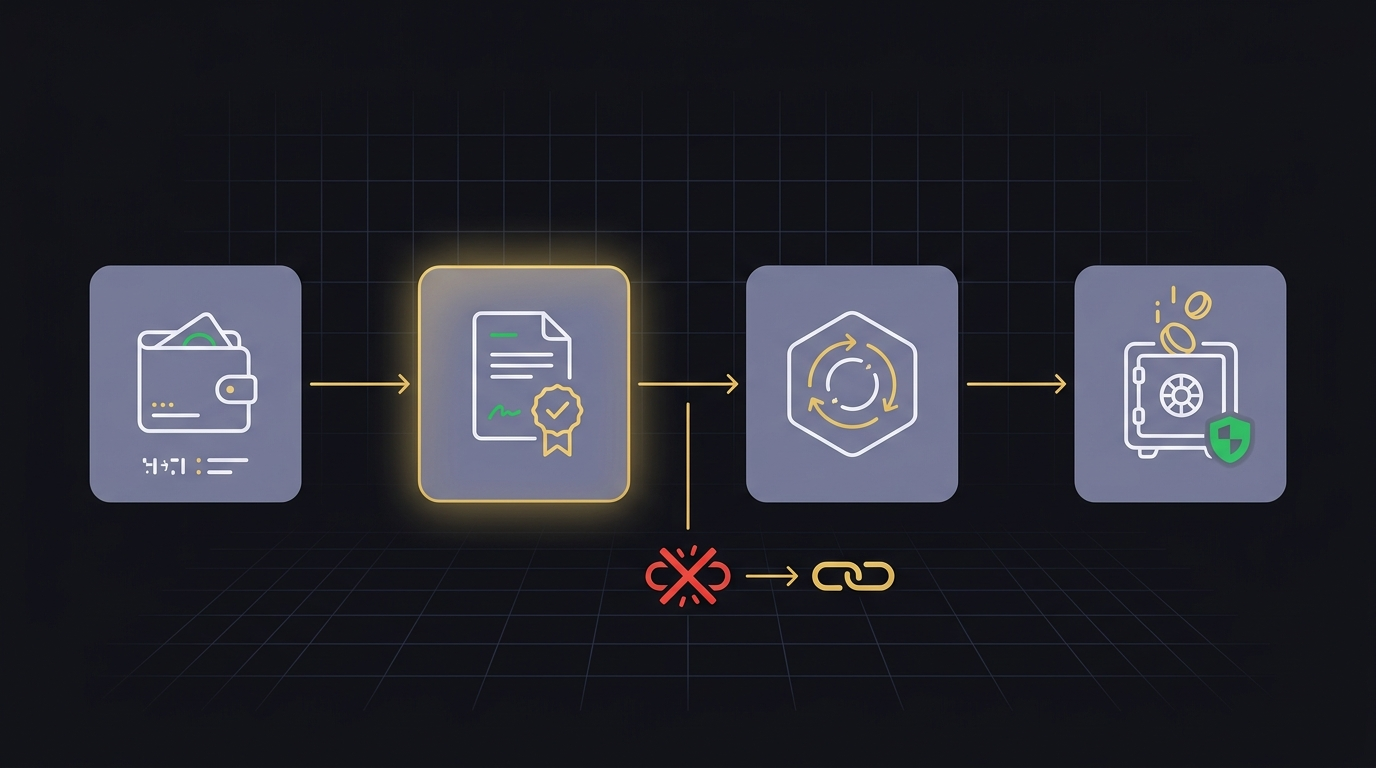
How does a permit flow work in practice?
- Quote: the treasury requests execution terms (strategy, amounts, chain) and reviews them off-chain
- Sign: an authorized signer produces a permit signature for the exact amount and a short deadline — no ETH spent, no transaction broadcast
- Execute: the protocol submits the permit together with the strategy call in one atomic bundle; if either fails, both fail
- Verify: every execution emits structured on-chain events (strategy ID, amounts, executor, chain ID) for audit
- Revoke: the allowance can be cancelled on-chain in a single transaction at any moment
Nothing is deposited into a pool at any step. The assets stay in the treasury wallet — this is the non-custodial model applied to the approval itself.
How do permits stay bounded and revocable?
Three constraints do the work. Exact value: the signature covers a precise amount, never an infinite allowance. Deadline: the authorization dies on its own — stale signatures cannot be replayed later. Single spender, single purpose: the permit names one contract for one strategy call. On top of that, standard revocation remains available: one on-chain transaction, callable by the wallet owner at any time, after which no further execution is possible until a fresh signature is issued.
Why does this matter for Safe multisig workflows?
Institutional treasuries usually sign through a Safe multisig. Permits fit that workflow: signers approve a readable typed-data message with visible amount and expiry instead of blind contract calls, no signer wallet needs ETH for approvals, and policy engines can gate which strategies, amounts, and chains are signable. Combined with KYC hooks and geographic restrictions, the result is an approval process auditors can actually follow — who signed what, for how much, until when.
How can our team evaluate it safely?
TRDEFI runs a 72-hour wallet-safe technical pilot: a chain/router matrix, testnet execution with signed permits, event verification against block explorers, and a live revocation drill — no mainnet funds required. If execution, reporting, and revocation all check out, a scoped live pilot with designated capital follows. Start from the main engine or ask for the pilot plan at info@trdefi.com.
Built for Gulf-region fintechs and corporate treasuries holding $500K–$50M+ in idle USDC/USDT float across Ethereum, Arbitrum, Base, and Optimism.
Explore yield.trdefi.com →