Yield Without Giving Up Custody: Virtual Strategies, Permits and Dock+Revoke in One Flow
Most explanations of non-custodial yield stop at the slogan: your assets stay in your wallet. This post walks the full flow instead — from the cost of doing nothing to the single transaction that stops everything — so a CFO, treasurer or auditor can follow every step. For the concept itself, start with what non-custodial yield is; for the signature mechanics, see ERC-2612 permits explained.
What does idle stablecoin float actually cost?
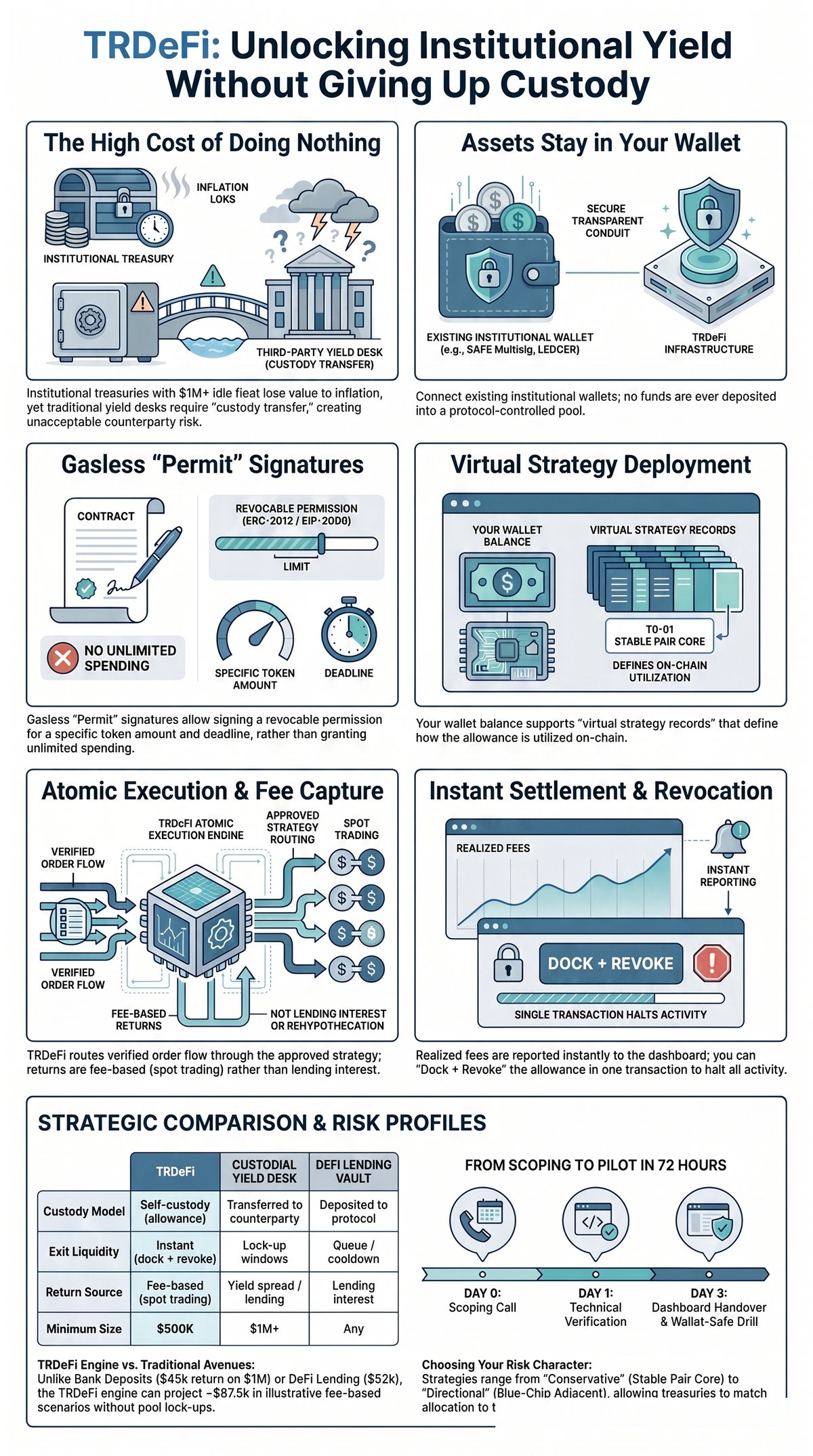
Institutional treasuries holding $1M+ in idle stablecoins lose twice: inflation erodes the balance while traditional yield desks demand custody transfer in return for access — creating counterparty risk most mandates forbid. Illustrative scenarios put bank deposits near $45k and DeFi lending near $52k per $1M, against roughly $87.5k in fee-based execution scenarios. Treat those as directional, not promised: the honest comparison is always net of friction — custody risk, lock-ups and exit queues included.
Where do the assets sit during all of this?
In your existing wallet — a Safe multisig, a Ledger, an EOA you already operate. Connection means authorization, not migration: no funds are ever deposited into a protocol-controlled pool. This is the property everything else hangs on. If a design moves principal into someone else's contract, it is not this model, whatever it calls itself.
How is spending authorized without an approval transaction?
Through a gasless permit: a signed message covering a specific token amount and a deadline — never unlimited spending. The protocol submits the signature together with the execution it authorizes, so approval and action are atomic. The mechanics are covered in depth in our permits post; the point here is architectural: bounded authorization replaces open-ended approval at the exact layer where treasury risk used to live.
What is a virtual strategy?
A virtual strategy (for example TR-01 Stable Pair Core) is an on-chain record that defines how an allowance may be utilized — not a pool that holds your tokens. Your wallet balance supports the record; the record routes flow. Strategies range from Conservative (narrow-range stable liquidity for operating floats) to Directional (higher fee density for designated risk budgets), so allocation matches the treasury's own risk budget instead of forcing one risk profile on everyone.
Where does the yield come from?
From verified spot-trading order flow routed through the approved strategy. The execution engine matches flow to strategy, captures the fee, and settles it to the treasury wallet — reported instantly with on-chain event evidence. Returns are fee-based: not lending interest, not token emissions, not rehypothecation. They scale with executed volume, strategy parameters and market conditions, which is why TRDEFI publishes history and projections never.
How do you stop it?
Dock + Revoke. One on-chain transaction cancels the allowance and halts all activity — instant settlement status, instant reporting, no exit window, no queue, no cooldown call with a desk. Compare the row that matters:
| TRDEFI | Custodial yield desk | DeFi lending vault | |
|---|---|---|---|
| Custody model | Self-custody (allowance) | Transferred to counterparty | Deposited to protocol |
| Exit liquidity | Instant (dock + revoke) | Lock-up windows | Queue / cooldown |
| Return source | Fee-based (spot trading) | Yield spread / lending | Lending interest |
| Minimum size | $500K | $1M+ | Any |
How fast can our team evaluate this?
In 72 hours, wallet-safe. Day 0 is a 45-minute scoping call (treasury size, chains, signer setup, compliance). Day 1 is technical verification on testnet — networks (Ethereum, Arbitrum, Base, Optimism), router, allowance-model testing. Day 2–3 is an optional live pilot plus dashboard handover with strategy state and transaction evidence. No mainnet funds move before you have seen execution, reporting and revocation work. Start from the main engine or write to info@trdefi.com for the pilot plan.
Built for Gulf-region fintechs and corporate treasuries holding $500K–$50M+ in idle USDC/USDT float.
Explore yield.trdefi.com →